- May 30, 2024
Gossip Is Good For Your Health
- Amy Connor
- 0 comments
The contents of this blog are covered in episode 7 of the Vagina Truth Bomb Podcast, which you can watch below:
Gossip:
Okay so let's start with the word itself...GOSSIP! I want to start by inviting you to take a moment to acknowledge and observe yourself! What comes up for you when you come across the word, gossip? Are there any changes in your body? Maybe you tense or clench parts of yourself? Maybe you catch your breath slightly? Do any thoughts, feelings or memories come up for you? Does a specific person come to mind? I am asking you to explore this as I am aware that it is a very emotive word especially relating to women.
Our society has done a really good job of associating women with gossip and making gossip out to be purely a negative and harmful thing. I see the impact of this a lot in my own interactions with women. I have noticed they apologise for being seen to 'gossip' with me. These women are my friends, my peers, professional associates and clients. They are kind and caring, with a lot of love to share with the world. They are not malicious, hateful or seeking pleasure in others struggles. Yet they feel that they are 'gossiping', that that is a bad thing and that they need to defend themselves.
This got me super curious as to why and how 'gossip' got such a negative reputation and why it is so strongly associated with women. I felt a sense of duty to explore this further. I am always sharing my passion to change the narratives around women's health and wellbeing to a more positive and informed one. So, when I realised the negativity attached to gossiping it felt right to explore the origins in more detail. What I found was super interesting so I have written this blog and also recorded a podcast episode.
Disclaimer: I am not a historian. The information I am sharing here may not be 100% accurate, but that doesn't take away from the narrative!
I started with a dictionary definition of gossip: "casual or unconstrained conversation or reports about other people, typically involving details that are not confirmed as being true." It was the last part of the definition which I have made bold that made me scratch my head. What would humans have to gain from spreading untruths?
The Origins of the Word:
The origins of the word gossip can be dated back to as late at the 12th century and an old English term "Godsibb." This word defined the modern Christian "godparent" role today. So the word has a religious starting point. Then it developed to mean friends or siblings who you could confide in and tell anything to, referring to both sexes.
It became associated with women more specifically as it was women who attended births. This association originates from the bedroom at the time of childbirth as giving birth used to be a social event exclusively attended by women. Where women from the community, friends, family and neighbours, would come to the bedroom of the birthing women to create a network of support.
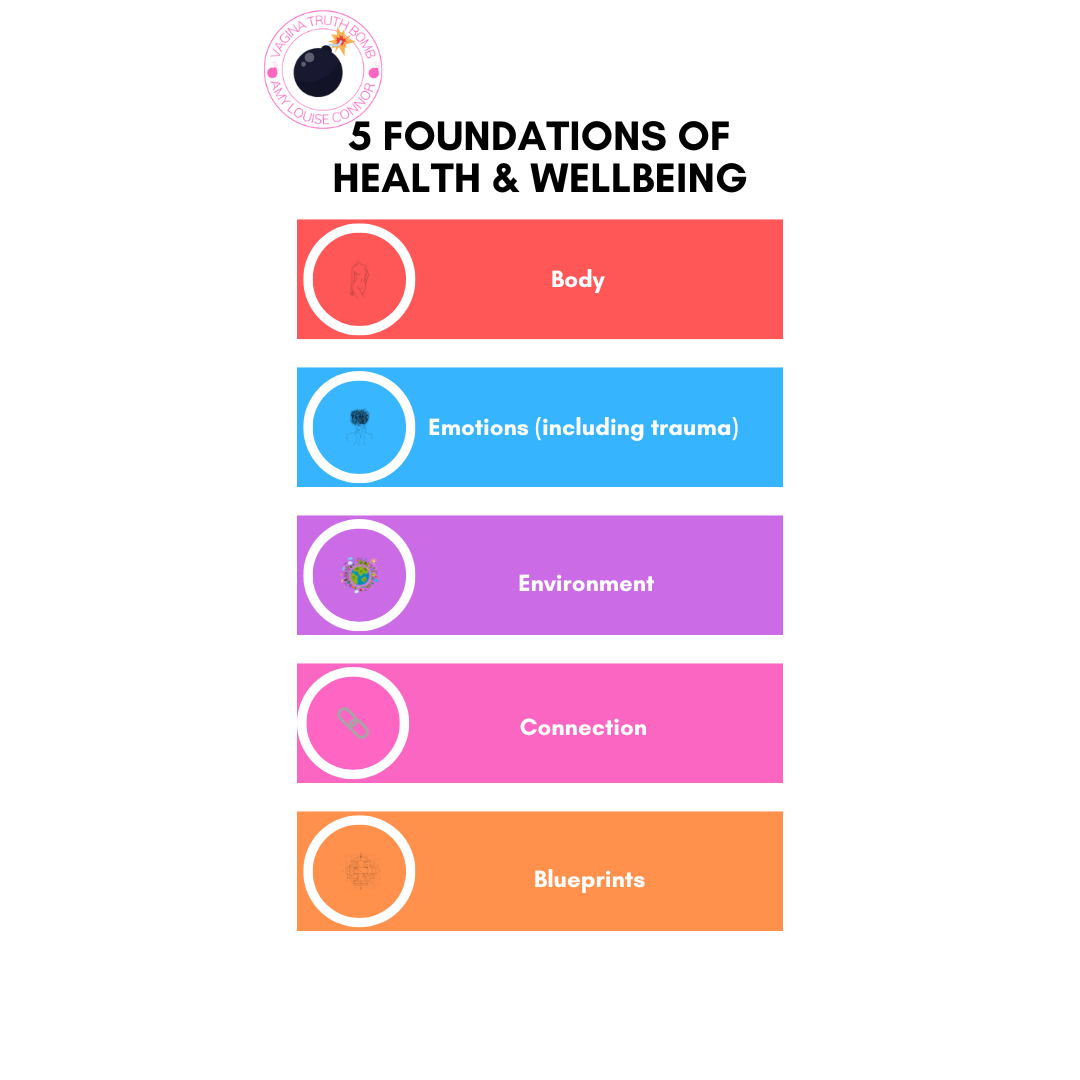
Personally, I love the idea of the mother to be being surrounded by the love, wisdom and support of other women. And for me it really highlights the need for and power of connection: one of my 5 Foundations of Health & Wellbeing.
It was not just at times of birth that women would come together. Connection, communication and gossip helped women to bond and show affection with one another. Put simply, in the middle ages women were 'homemakers' and very much separate from the 'politics' of the man's world. It was common for women to meet in cycles and ‘gossip’ / talk / connect. The gossip played an important role in allowing the women to know who they could trust and who would help them and their families to stay safe and alive.
Oh Hello Patriarchy! 👋
Overtime men became concerned about these women's circles as they believed that the women discussed all matters with no regard for the public eye or politics that they/the men had created. Men worried that if the women gained too much confidence or power that they could ‘rise up’ and challenge their rules. Hence the word gossip was moved away from it's religious roots and became recognised as a dangerous act, even seen to be associated with witches!
Eventually laws were made against women who gossiped, held the friendship circles or nagged. Either in their homes or in public. Gossiping evolved from meaning strong female friendships and companionship to 'women engaging in idle talk.'
In 1547, a proclamation was issued “forbidding women to meet together to babble and talk,” ordering husbands to “keep their wives in their houses.” If women didn’t rejoice in their newfound captivity, they would put themselves at risk, and could be accused of being a witch. And during trials, they were encouraged (under the penalty of torture) to snitch on their friends, sisters, mothers, daughters.
Men sought to control women....yes hello patriarchy! Any woman seen guilty to be gossiping or simply standing up for herself / speaking her truth was at risk of punishment, especially if it was against men would be accused of being a 'Scold.' Punishments were absolutely hideous and brutal including the Scold's or Gossip's bridle, death by drowning and immolation (burning to death).
The Scold's / Gossip's Bridle.
The “Scold” part of “Scold’s Bridle” comes from the term that was usually applied to a woman in a derogatory sense, who is seen to be nagging or constantly displeased. Husbands could request the Scold's Bridle for their nagging wives, allowing them to control their spouses! The “Bridle” part, of course, comes from the headpiece worn by horses, used when their riders want more control over their movements. The device held the wearers tongue in an iron gag which was often spiked to cut their tongues if they tried to talk. The women would either be chained up some where publicly or lead around the town on a lead for further humiliation. The public would jeer, spit and throw things at them. 😥
On of the earliest recorded uses of the Scold's Bridle is in Edinburgh 1567 when Bessie Tailiefeir (pron. Telfer) slandered Baillie Thomas Hunter in Edinburgh, saying that he was using false measures. Incredibly, the crime of being ‘a scold’, a woman deemed to be annoying or vexatious, was not dropped from the statute books in Britain until 1967. Yep, read that again...1967!😮
Of course men also gossiped and 'scolded', and still do! However, theirs was deemed important and necessary. As women were jobless only other women took them seriously. Men gossiping was seen more as networking: a productive and valid pastime. As women could be punished for not speaking out against or snitching on other women, it became dangerous for women to use their voices! The impact on this in relation to women's health & wellbeing has been HUGE! Not to mention the fact that our entire health care system has been built by a patriarchal system that doesn't understand the female body...and in which many women feel misunderstood and ignored.
Applying Gossip to the 5 Foundations of Health & Wellbeing:
In a nutshell: Gossip creates connection, which has a positive impact on our body. It also creates a much safer environment that allows for true expression of our emotions/trauma. Gossiping also allows women to give voice to their intuition (blueprints).
Gossip Is Good For Your Health:
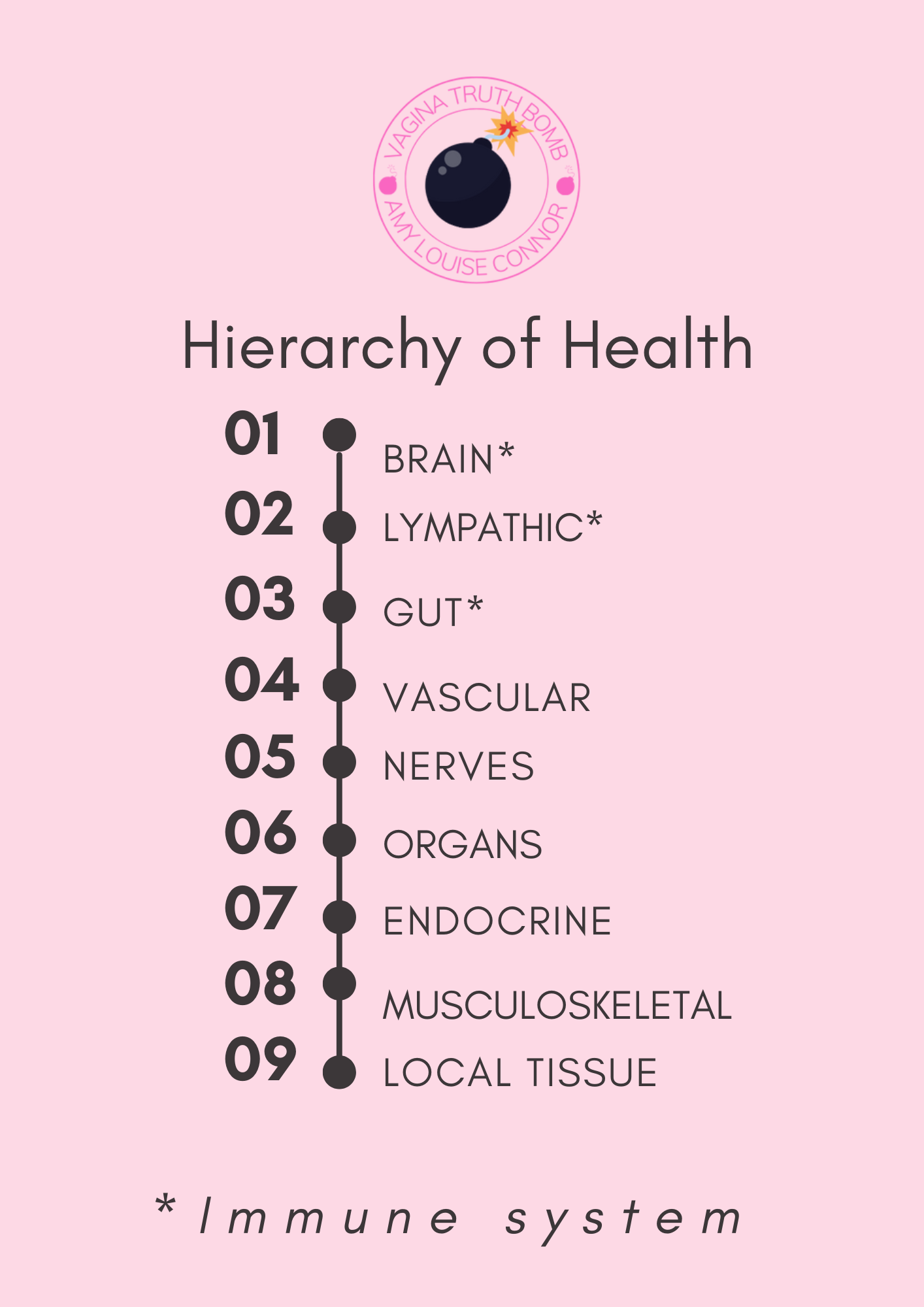
As I mentioned earlier, when we come together to gossip, we are creating connection between ourselves and those we are gossiping with. This connection enables the body to feel safe, as our brains (nervous systems) need connection and gossip to help them feel safe. Research has shown that talking amongst 'friends' releases happy, feel good hormones such as serotonin and oxytocin as it helps to create an emotional connection. We all know how good it feels to have a good vent and 'get things off of our chest', as it helps us to feel release of anxiety and stress. When we share how others have hurt us we are provoking understanding and empathy from others. This is so good for our brains and nervous systems. And remember the brain is at the top of the Hierarchy of Health, so anything that keeps the brain happy and safe is a good thing:
In the related podcast episode, I talk more about how gossiping helps women, work with their intuition, build empathy, stay safe, celebrate each other and understand ancestral wounding.
Reclaiming & Redefining Gossip:
Now I know the story of gossip, and how the patriarchy manipulated it to control women, I feel passionate about reclaiming it back! I am currently pondering a VTB definition of gossip, which I will share once I have finalised.
I believe that as women we can come together to remove the negativity and shame surrounding it and gossip for good. OOO let's make that a hashtag #gossipforgood.
I invite you to comment below if you feel the same and wish to join me on this reclamation! I also invite you to share your thoughts and feels from this article and gossip in general.
I have actually decided to re-name my email newsletters, Vagina Truth Bomb Gossip, and fill them with #gossipforgood.
Thank you for reading, much love Amy 😘.
This article has contained some pretty upsetting pieces so please ensure you acknowledge this. Take a few minutes to gift your nervous system to some nice deep, slow breaths, and if possible do something that makes you feel good. For example, hug a loved one (dogs are great for this) or yourself. 😍
About the Author:

Hi I am Amy...I am the founder of Vagina Truth Bomb and a Women’s Health & Wellbeing Mentor.
I offer a uniquely holistic approach to help you overcome your health & wellbeing challenges, incorporating my 5 Foundation of Health & Wellbeing:
🧠 Body
🎭 Emotions
🌎 Environments
🤝 Connections
🔵 Blueprints
I have a Telegram community accessible to women who wish to improve their health & wellbeing. Come and join us.
My References:
Here are the article that I read when researching this topic! I want to acknowledge them and recommend them for further reading on the topic.
https://www.thewomens.network/blog/the-evolution-of-gossip
The Scold's Bridle: The Cruel Punishment For So-Called 'Scolds' (allthatsinteresting.com)
https://www.scottishlegal.com/articles/our-legal-heritage-the-branks-or-scold-s-bridle